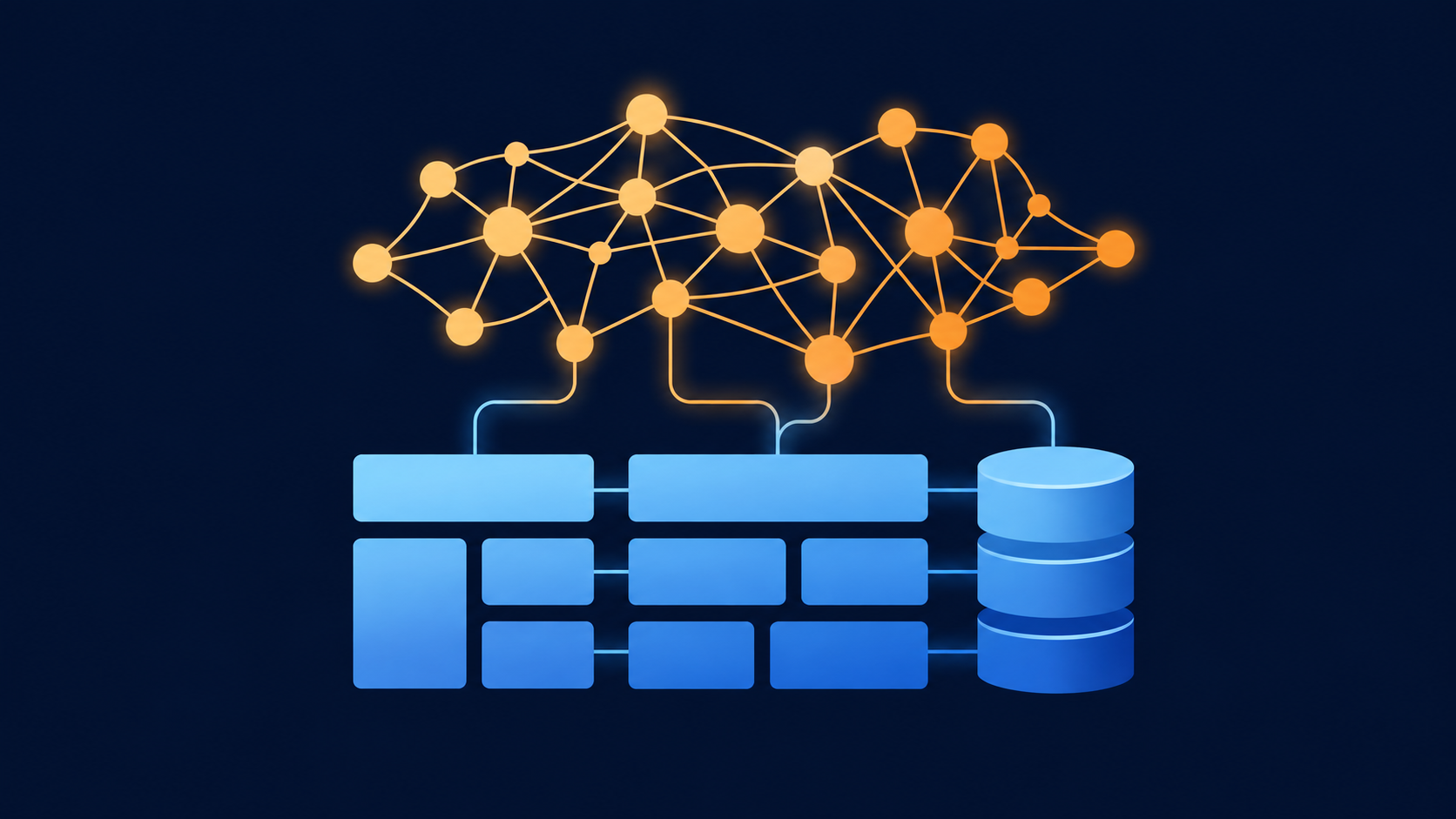
For a decade now, “full-stack” development has referred to a single architecture consisting of a frontend framework, a REST or GraphQL API, a relational database, and a cloud host. This allows for a single developer to fully understand a system and even to work on it alone.
That’s not true for AI products. Most teams haven’t caught up to that yet.
The gap between "using AI" and "building AI-native"
Gartner, in their report, predicts that by 2026, 80% of enterprises will be releasing full-stack applications that include AI in the core of their applications. Meanwhile, developer surveys reveal that over 90% of working developers are using AI-assisted coding on a daily basis. However, it is worth noting that these two numbers are often confused and actually describe two very different things.
While most teams have solved for the first (using AI to write normal software faster), they have not yet solved for the second (building fully AI-native products). This means that while most teams have solved for the first, they have not yet solved for the second. And this means that very soon, most teams will start to see problems with their architecture that they had not anticipated. These problems will start to show up as technical debt within 6 months of launch. And not 2 years from now.
Why the traditional stack breaks under AI workloads
A standard CRUD application has very predictable request shapes, i.e., a data structure is sent to a server for storage, and later a similar data structure is retrieved and rendered on a screen. In contrast, an AI application has very non-deterministic request and response shapes. This leads to a breaking of the existing stack in three places.
1. The database layer needs a second brain
When we talk about AI-native applications, we need to remember that the database layer for your AI-native application needs a second brain, which in this case are vector stores, embeddings, and retrieval pipelines for your RAG. This means that your relational data and your vector store need to form a single, consistent data layer. This means that changes to your relational data need to be propagated to your vector store and changes to your vector store need to be propagated to your relational data. Treating your RAG as ‘just another API call’ will result in your embeddings forming a slow-moving, big ball of mud and your retrieval failures forming a silent, slowly growing set of errors that will ultimately affect the answers that your users receive in production, long after the demo has finished.
2. Latency budgets get rewritten
Latency budgets for developer products will be rewritten. Model call times will vary from 300ms to 8+ seconds, depending on what the model is doing. So, frontend developers who are used to loading states for API calls that take 200ms will now have to design for uncertainty, coming up with ways to stream partial output to users, showing them intermediate steps in a process, and dealing with timeouts in a variety of ways. This is a frontend architecture problem as much as a backend architecture problem.
3. Cost becomes a runtime variable, not a fixed line item.
The cost to deliver features is no longer fixed. The cost of the same feature for different users can vary by a lot (e.g., 3x cost for the same feature for different users based on conversation). This cost needs to be instrumented at the API layer very early on to prevent a big surprise when the bill arrives from AWS/inference. The cost can vary based on length of input and output (e.g., $x*length_of_input*length_of_output) and number of tool calls an agent makes to complete a task (e.g., $x*number_of_tool_calls). The cost for the same feature for different users based on conversation can vary by a lot.
Agentic AI is accelerating the split, not slowing it down
As mentioned before, conversational AI is a well-known problem in AI research, and it’s now finally a well-known problem in the developer reports 2026. As mentioned before, there’s a clear shift happening, and most developers agree on that. Instead of just answering questions in a conversation, AI systems now are expected to act in a more agentic way. This means that developers now build systems that can plan and act, that can call tools, and that can execute a number of steps in order to reach a goal. This is clearly a huge shift in terms of what kind of architecture is required to support this kind of AI.
That shift multiplies the architectural surface area: an agent needs state management across steps, error recovery when a tool call fails, audit logs for what it actually did, and guardrails on what it's allowed to touch. None of that lives comfortably in a codebase designed around single-request, single-response thinking, which is exactly the gap we address in our full-stack development work.
This is also why the "one full-stack developer can own everything" model is under real pressure. It's not that generalists are obsolete, it's that AI-native products need generalists who also understand retrieval architecture, model orchestration, and observability for non-deterministic systems. That's a different hiring bar than "knows React and Node," and it's part of why we wrote about why Indian startups are increasingly choosing an AI workforce over traditional hiring.
What this means if you're building an AI product in 2026
Some things that are working for founders and product teams building AI products right now.
- Design the data pipeline before the UI: If retrieval quality is bad, no amount of frontend polish fixes the product. Get embeddings, chunking strategy, and freshness right first.
- Design for partial, streaming output by default: Design for slow processes that are transparent to users. Design for partial output that is being streamed to users. Users will tolerate slow processes if they can see what is happening in real time. But they will be very unhappy with fast processes that are opaque to them.
- Cost tracking at the API level: As for database query tracking (e.g., in milliseconds) to establish cost per request (in dollars per request) in weeks, not months.
- Treat agent actions as auditable events: This means that for every action taken by an AI in your product or service, there needs to be a record of why it was taken.
None of this replaces solid full-stack fundamentals — it sits on top of them. It also doesn't stop at the codebase: a product built on shifting architecture needs a discovery strategy that keeps up, which is the same reasoning behind our take on website speed and architecture as an AI ranking factor. But teams that keep architecting AI products like 2019-era web apps are going to keep shipping demos that don't survive contact with real users. The teams pulling ahead in 2026 are the ones who accepted early that "full-stack" now has two layers to master, not one.
---
MyAibo builds full-stack AI products and the marketing systems around them — from retrieval architecture to the GEO strategy that gets them found. Book a strategy session if you’re navigating this shift.