Have you heard about that three-month-old D2C brand based out of Bengaluru running with just four employees? Despite the small headcount, they’re somehow offering 24/7 customer service and churning out three SEO-optimized articles every single week. On top of that, they are running real-time ads and sending highly personalized emails to a list of over 50,000 subscribers.
So, how exactly are they pulling this off? It sounds like science fiction, but it's happening right now: Indian startups are actively shifting their mindset from simply "hiring" a massive team to "deploying" an intelligent workforce. As we navigate 2026, the big conversation in the boardroom has completely shifted. Founders aren't just asking, "Who should we hire next?" They're asking, "What can an AI agent actually do for me?" Let's dive into why this shift is taking over and how it can practically fuel your startup's growth.
The real cost of building a team in India
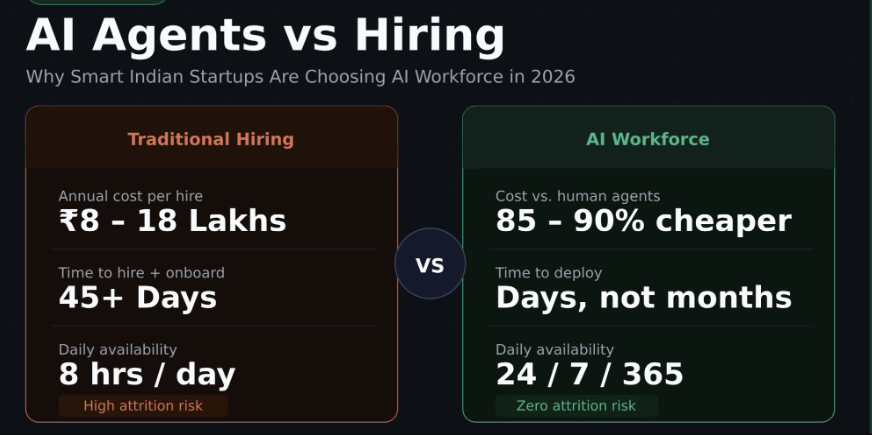
Hiring a functional startup team will cost way more than most founders have estimated. Building a growth team with a content writer, social media manager, performance marketer, SEO specialist, and customer support executive will cost anything between ₹8-18 lakhs a year. And that’s excluding the recruitment fees, the time it will take for them to get up to speed, the benefits, etc., that you will have to bear.
There is also the reality of limited productive hours. After accounting for ramp-up time, task switching, and inconsistent output, knowledge workers are actually only productive for less than half their hours in the workday. And we know for a startup at the Seed or Series A stages that wasted productivity is valuable runway.
Let’s be honest, most founders end up following the more traditional hiring model.
What actually is an AI agent?
Let’s understand from the grassroots level. An AI agent isn't just a glorified chatbot, search engine or smart query engine on a website. Think of it as an autonomous team member. You give it a goal, and instead of just spitting out advice, it rolls up its sleeves, figures out the steps and actually executes the work. The core feature of an AI agent is that it functions autonomously, i.e., without human intervention for every step.
For a goal like ‘Grow organic traffic by 25% this quarter’, an AI agent does far more than suggest article topics. It will research the best keyword clusters to target, audit your current web pages for optimization, write article drafts (optimizing for the highest possible rankings for you), and then monitor the web rankings of all published articles. It will then optimize the plan based on the strongest results. It will complete the entire process from start to finish for you.
The numbers that are shifting the conversation
AI agents are having a revolution. The numbers don’t lie: The global market for AI agents grew to $10.91 billion in 2026 with a 43% year-over-year increase. The sector is the fastest-growing area of software, behind only cloud. For this year’s GPU Technology Conference, NVIDIA’s State of AI Report 2026 finds that 44% of companies have moved from AI experimentation to AI deployment. The sectors leading the charge are telecommunications (48% adoption rate) and retail (47% adoption rate).
However, there is a critical number to be aware of: the cost of using AI agents for customer interactions ranges from $0.25 to $0.50 per interaction, compared to $3 to $6 per interaction charged by human agents for similar interactions. This can create significant unit economics on thousands of customer touchpoints of contact per week when supporting unit growth.
Where AI agents actually beat human hires
In 2025, the McKinsey Global Institute published a report where they analyzed work done by humans around the world and found that 57% of work hours could be automated with current technology. As opposed to the usual AI-apocalypse type of paper, where man fights against the machines, the focus is on the human-agent-robot partnership and how it can be skilfully used to get work done in organizations.
The 5 Roles at a startup where AI is currently better than hiring.
Content and SEO operations: By doing research, writing, optimization, publishing, and monitoring of online content for startups, AI agents are extremely cost- and time-efficient. Startups that are trying to establish organic authority without a 5-person-strong content function have a natural structural advantage by using AI for their online content.
Customer support: Human support teams often take hours to respond. On the other hand, using AI, companies have seen response times reduce to less than 4 minutes, and the average resolution time for queries to be solved has reduced from 32 hours to 32 minutes.
Performance marketing and analytics: Imagine having a teammate who watches your marketing campaigns 24/7. If an ad isn't pulling its weight, the AI catches it instantly and shifts your budget to where you're actually getting a return on your ad spend. The AI will also alert early enough in time should there be any sign of wear of the creatives used for marketing activities online. Last but not least, an AI for performance marketing and analytics will also automatically generate summary reports of campaign results.
Lead qualification and CRM management: The AI agent scores incoming leads and can even write out a personalized sales sequence to send to potential customers. It frees your sales reps from the mind-numbing grind of early-stage lead qualification.
Market research and competitive intelligence: No need to brief a junior analyst every week for market research. The research agent scans the latest moves of your competitors, tracks keyword trends and general industry developments, and draws the right conclusions for you to use in structured briefs on a schedule of your choice.
The Indian startup advantage
Asia-Pacific AI agent adoption is growing at 52% year-over-year and is the fastest-growing geography. And within that, there is a structural edge that India’s startup ecosystem offers that hasn’t been talked about enough.
Indian startups are largely lean and hence do not have legacy processes or a bloated organizational structure that needs to be unwound. Hence, their entrenched workflows are unlikely to resist change. Indian startups also have access to a deep technical talent pool that can help them build, customize, and run intelligent AI-powered systems. With over 120,000 AI professionals and 185+ AI/ML Global Capability Centres, India now boasts of a talent infrastructure that rivals the best AI hubs in the world.
The ones winning at scale are those who are able to utilize this massive pool of human capital to build more intelligent systems, as opposed to adding more humans to the teams of already lean startups. It is the emerging AI systems that Indian startups can leverage to scale up, given their unique lean design-to-launch model.
But what about jobs?
There is a lot of positive press around new jobs created by AI; however, many jobs are getting automated. A vast majority of those are entry-level, very repetitive, and will get automated at scale. McKinsey has recently published a report outlining which jobs will be automated in the future.
What’s really happening is that the value that people bring is being amplified. Thus, the companies that can get this right are building out something far more sustainable than prior companies that essentially had people complete headcount-driven tasks, get paid, and work in an ‘efficient’ workplace. The work of the marketer, the work of the analyst, and so many others are being dramatically rethought.
What your best humans can do and how to use AI to amplify their value to create more in your company than by cutting headcount and touting efficiency in removing jobs that have been displaced by AI.
The smart play: Hybrid AI-Human teams
Indian startups of 2026 are not relying entirely on AI for scaling up. Nor are they going back to the old hiring ways. What is working for them is building hybrid teams of humans and AI agents. The human will define the strategy, build relations & exercise judgement, while the AI agents will execute, monitor & optimize for them at scale.
You hire a head of growth who designs a growth vision for your company, and an AI-powered growth agent executes on that growth vision by running campaigns. You hire a customer success lead to handle escalations for your customers. An AI-powered customer success agent manages first contact for 90% of your customers and all subsequent interactions with them. You hire a brand strategist who owns the voice and brand for your company. An AI-powered content agent then produces and distributes tonnes of content daily for that brand.
Not only will you save a lot of money, but you will also create a powerful competitive advantage as the agent becomes more and more refined as it runs longer within the specific context of your company, your customers, and your goals.
How MyAibo builds your AI workforce
This is what MyAibo was made for. We design and deploy custom autonomous business agents that run real startup workflows such as content operations, customer engagement, lead pipeline management, competitive analysis, and more. Our smart process optimisation does not start with tools; it starts with the biggest operational bottleneck in your business and then builds the intelligent system around it.
Whether you are at the idea stage or post-Series A, the right approach to building an AI workforce to support your growing company is to have a team work with you to scope, build, and calibrate an AI workforce tailored to the specifics of your business model. No templates are used.
The window is narrowing
Founders in 2012 thought it was a better idea to wait and observe for the cloud to ‘mature’ before they jumped into it. Instead, they spent the last 10 years catching up to their competitors. The same risk is unfolding for the AI agents’ revolution currently.
In 2026, the debate over whether AI agents are real will be a thing of the past. This fact will be apparent to anyone who cares to read the data coming out of MckInsey, the rates of deployment to production, or the unit economics. The only question facing your startup is whether you will be leading the charge or simply following in the wake of the pioneers.
For Indian founders with big ambitions and limited time, the answer should be obvious.
Ready to build your AI workforce? Let's talk.