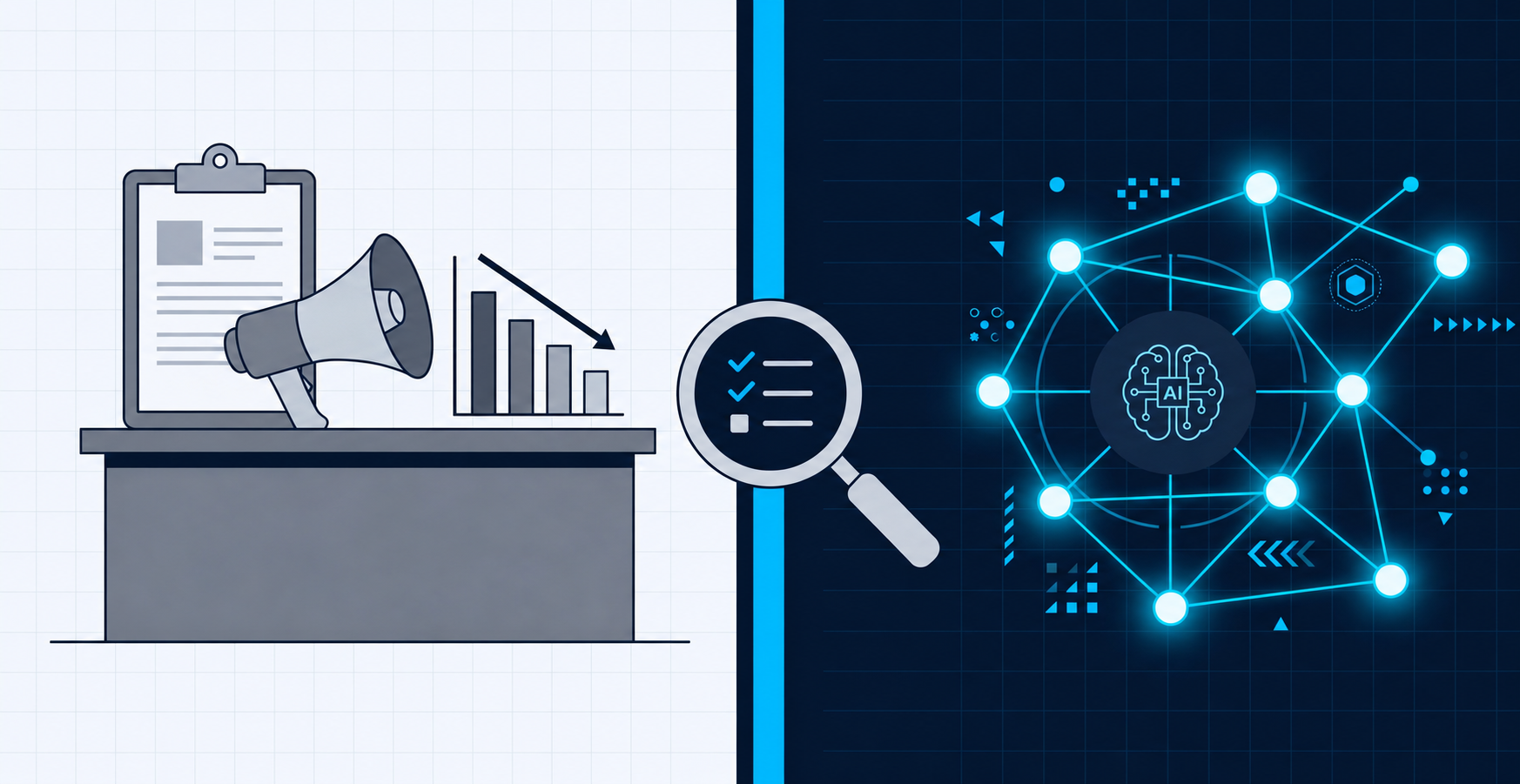
Every marketing leader evaluating agency partners this year faces a question that didn't exist five years ago: should we hire a traditional marketing agency or an AI-native one?
The line between the two isn't always obvious from a pitch deck. Most agencies now claim some AI capability — a chatbot here, an "AI-powered" dashboard there. But there's a meaningful difference between an agency that uses AI tools to execute an old playbook, and one that has rebuilt its entire practice around how discovery, content, and customer behavior actually work today.
Getting this choice right matters more than it used to. The wrong partner doesn't just slow you down — it can mean your brand quietly loses visibility in channels your competitors are already winning. Here's a practical framework for telling the two apart and knowing which one your business actually needs.
What "Traditional marketing agency" actually means today
A traditional agency's core competency is built around channels that have existed for a decade or more: paid search, paid social, keyword-based SEO, and content calendars optimized for organic rankings. Many are excellent at what they do. The issue isn't competence, it's scope.
Traditional agencies typically:
- Optimize primarily for Google's traditional organic results and paid placements- Measure success through rankings, impressions, and click-through rate
- Treat AI as a productivity tool internally (faster copywriting, faster reporting) rather than as a discovery channel to be optimized for
- Run SEO, content, and paid media as separate workstreams, often with separate teams or vendors
- Have limited or no in-house capability to build technical systems such as automation, AI agents, or custom software, beyond marketing execution
This model works fine as long as your customers are still discovering you the way they did in 2020. Increasingly, they aren't.
What "AI-native agency" actually means
An AI-native agency isn't defined by using AI tools — nearly everyone does that now. It's defined by treating AI platforms (ChatGPT, Perplexity, Google AI Overviews, Copilot) as a first-class discovery surface, with the same rigor traditional agencies apply to Google rankings. And, often, by having genuine technical capability to build AI systems for clients, not just market around them.
An AI-native agency typically:
- Runs Generative Engine Optimization (GEO) and Answer Engine Optimization (AEO) alongside SEO — structuring content so AI platforms cite and recommend the brand, not just so Google ranks it
- Measures success partly through AI citation rate — how often the brand is surfaced inside AI-generated answers — alongside traditional traffic and conversion metrics
- Treats SEO, AEO, GEO, and content as one integrated system rather than siloed services
- Has in-house engineering capability — AI automation, agentic workflows, full-stack development — not just marketing execution
- Builds for entity recognition and machine readability (schema markup, structured data, E-E-A-T signals) as a core discipline, not an afterthought
The distinction matters because these are genuinely different skill sets. Optimizing for a ranking algorithm and optimizing for a language model's understanding of your brand are related but not identical disciplines — and most agencies have only built expertise in the former.
Five questions to ask any agency you're evaluating
If you're not sure which category a prospective partner actually falls into, their pitch deck won't tell you. Their answers to these five questions will.
1. "Do you track AI citation rate, and can you show me an example?"
This is the single clearest litmus test. If an agency can't define this metric or has never reported on it for a client, they are not doing GEO work, regardless of what their proposal says. Ask for a before/after example with real numbers.
2. "Walk me through how you'd structure a page for AI extraction versus for Google ranking."
A traditional SEO team will talk about keyword density, meta descriptions, and backlinks. A genuinely AI-native team will talk about entity clarity, direct-answer formatting, schema markup, and how large language models parse and cite structured content. The difference in vocabulary alone is revealing.
3. "Do you have in-house technical/engineering capability, or is that outsourced?"
Many agencies that call themselves "AI-powered" are entirely marketing-side, with no ability to build automation, AI agents, or software. If your growth challenge eventually needs a technical solution — a lead-routing system, a recommendation engine, an internal automation tool — you'll want a partner who can build it, not one who has to sub it out and lose accountability in the process.
4. "How do you measure ROI as hours billed or outcomes delivered?"
Traditional retainer models often bill for time and activity. Look for agencies structured around measurable KPIs — conversion lift, CAC reduction, citation rate, automation rate — with clear accountability tied to results, not just deliverables.
5. "Can you show me results from brands in our industry or a comparable one?"
GEO and AEO are still new enough that genuine, vertical-specific case studies (not just generic "AI marketing" claims) are a meaningful signal of real experience versus repositioned marketing language.
When a traditional agency might still be the right choice
To be fair, an AI-native approach isn't automatically the right fit for every business. If your customers primarily discover you through offline channels, referral, or highly localized search with minimal AI-assisted research behavior, the urgency is lower, though it's rarely zero, and shrinking further every quarter as AI-assisted search adoption grows across categories in India.
If your priority is a narrow, well-defined channel like paid social performance for a single campaign — a specialist traditional agency may execute that specific task better than a broader AI-native partner. The decision isn't always binary; some brands run a traditional agency for paid media alongside an AI-native partner for organic and AI visibility.
The real risk of waiting
We've written before about how zero-click search is reshaping traffic for Indian businesses — and the trend is accelerating. The bigger risk for most brands isn't picking the wrong agency model; it's delaying the decision entirely. Search behaviour has already shifted: the majority of users now trust AI-generated answers over traditional search results, and a majority of queries are resolved without a click. Brands that build AI-native visibility now are establishing authority signals that compound over time, the same way early SEO adopters built a durable head start over competitors who waited a few years too long.
If your current agency can't clearly answer the five questions above, it's worth having that conversation soon, not because your existing partner is necessarily doing bad work, but because the category of work required has expanded, and not every agency has expanded with it.
How MyAibo fits this framework
MyAibo was built specifically to close this gap. We're a boutique, Bengaluru-based agency running GEO, AEO, SEO, and content marketing as one integrated system, not as fragmented services split across vendors alongside genuine in-house technical capability in AI automation and full-stack development. Our engagements are structured around measurable outcomes: AI citation rate, conversion lift, and cost-per-acquisition, not billable hours.
If you're currently evaluating agency partners and want a second opinion on where your brand actually stands, in traditional search or in AI-generated answers, that's a conversation worth having before you sign anything.
Not sure which category your current agency falls into? Book a free strategy session with MyAibo — 30 minutes, no commitment, and we'll show you exactly where your brand shows up (or doesn't) in AI search today.