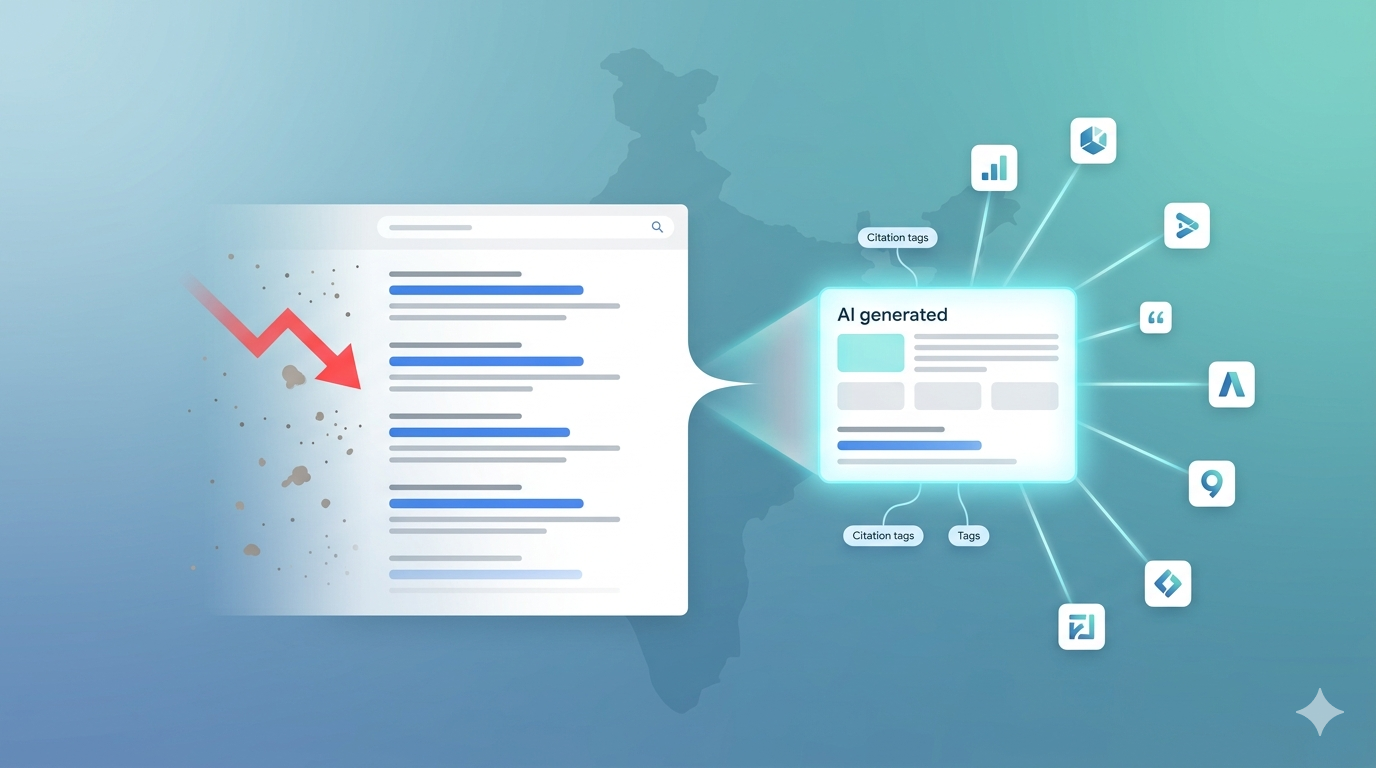
The search engine you knew is gone
You spent months writing the best blog post possible. You did perfect keyword research and perfect on-page SEO and finally, Google graded you for your hard work and gave you a top-3 ranking. But after a year, your organic traffic took a massive hit of 35% and the blog post stopped moving on the rankings altogether.
Welcome to the Zero-Click Era.
A study conducted in 2026 revealed that as many as 68%+ of all Google searches globally were ‘zero-click searches’ and were instantly answered by Google’s AI-powered search algorithm or by a featured snippet or knowledge panel in search results. The trends for the number of searches that actually generate clicks, or links to other websites, are also rapidly falling. While this news may spell doom for many businesses that have spent thousands of rupees to create quality content and carry out SEO, it doesn’t have to spell the same for Indian businesses as well. All they need to do is learn the new rules of the game.
What exactly is zero-click search?
'Zero-click search' refers to the new generation of search that directly answers users’ search queries on search results pages, without requiring them to click through to a web page that contains the answers. Google’s AI-powered Overviews, launched in 2026, have rapidly accelerated this phenomenon.
Here's what's eating into your traffic today:
AI Overviews: Google’s new generative AI now combines multiple sources to offer direct answers to search queries, beating out organic results.
Featured Snippets: Google search results for certain queries now return short ‘boxed’ answers to basic questions above all other normal results.
Knowledge Panels: Google’s ‘information cards' that display information about brands, people, organizations and places.
People Also Ask (PAA): This is a collection of questions related to a search query that are displayed in a question-and-answer format below the regular search results. They are designed to keep users engaged on Google for longer, without having to click through to other pages on the web.
Google Maps and Local Packs: For queries that pertain to businesses, Google is answering them within Google itself.
Ranking #1 on Google is no longer enough to drive traffic. This new model of search is fundamentally broken for information-driven businesses that rely on creating content to drive business through guides, how-tos and explainers.
India is especially vulnerable: here's why
There is no greater challenge for the digital marketer than the opportunity of the Indian market, with over 600 million online users and an online economy growing at a rate that is among the fastest in the world. And this is a Google-centric market like no other: with over 97% of all search traffic captured by the search giant, the digital marketer in India has a particularly tough task to get visibility for their business online.
The rapid growth in voice-based search and conversational search on Google, thanks to affordable 4G-enabled smartphones, adoption of regional languages in search (Hindi, Tamil, Telugu, Bengali, Kannada and many more) and Google Assistant penetration in Tier 2 and Tier 3 cities of India.
Long-tail and conversational voice search queries are more likely to trigger overviews or featured snippets (‘content’) as opposed to blue links. The large young user base in India is used to asking questions and receiving immediate answers. Hence, this content is getting consumed through Gemini or ChatGPT as opposed to Google Search.
The new game: GEO and AEO
As ‘Zero Click’ becomes the future of search for Indian businesses, they can get ahead of the competition and create a ‘moat’ around their brand by focusing on two key areas – Generative engine Optimisation (GEO) and Answer engine optimization (AEO).
Generative Engine Optimization (GEO): As ranking on search engines still holds relevance in the zero-click era, forward-thinking businesses are now focusing on Generative Engine optimization or GEO, for short. Essentially, this form of SEO focuses on creating relevant content on a company’s website, which can be used by AI systems such as Google AI Overviews, ChatGPT, etc. to provide answers to potential customers. The answers are generated from content created on the client’s website by SEO experts, and this is becoming highly relevant in the Zero Click Era as well.
Answer Engine Optimization (AEO): Structure your content in such a way that answer engines (featured snippets from Google, voice assistants from your smartphone, etc.) can pull required information from your website when a direct question is put forth in search.
Together, GEO and AEO mark the beginning of the new search visibility frontier and the way businesses can gain a competitive edge in the zero-click era by creating content that earns the trust of AI models and gets quoted in their answers.
MyAibo helps businesses across India in AI-powered SEO, GEO and AEO to rank higher and become the answer.
5 strategies to win traffic in the Zero-Click World
1. Structure content to answer questions directly
This content is optimized for AI, and featured snippets that read point to point. Each section of the content is written in an ‘answer-first’ format, i.e., each section starts with a direct answer to a question (circa 40-60 words). The rest of the content in the section then elaborates on the answer with more detail and context. It is significantly different from those infamous keyword-heavy blog posts of 2019 that went on for ages. For each of your key pages, such as your FAQs on your pages, use your FAQ sections with JSON-LD schema markup.
2. Build Real E-E-A-T Signals
Google’s E-E-A-T framework (Experience, Expertise, Authoritativeness, and Trustworthiness) has moved from being a ‘guideline’ to one of the key determinants in AI linking between articles and thus between your articles and those of your competitors. For Indian businesses, this translates into ensuring that they can verify their experience and also establish their expertise in the articles they write and then garner mentions in credible Indian media and industry publications.
3. Optimise for People Also Ask and AI Overviews
The PAA box and AI Overviews now appear across a significant and growing share of commercial and informational queries. Research PAA questions in your niche using Google itself, and build concise content clusters around each one. Tools designed specifically for this new landscape, like HubSpot AEO, which was launched to help marketers track and improve their brand's presence across answer engines like ChatGPT, Gemini and Perplexity, is making visibility measurement and optimization far more accessible for businesses of all sizes.
4. Double down on Bottom-of-Funnel content
Here's the counterintuitive insight redefining content strategy in 2026: zero-click search predominantly impacts top-of-funnel informational queries. Transactional and high-intent comparison queries like the ones where someone is genuinely about to spend money still drive clicks at substantially higher rates.
Prioritise content that serves buyers who are close to a decision:
"Best AI marketing agencies in Mumbai for e-commerce brands"
"GEO vs AEO — which strategy is right for my Indian D2C business?"
"How much does AI-powered SEO cost in India in 2026?"
These high-intent queries continue to deliver clear, measurable ROI even in the zero-click world.
5. Track brand citations and not just rankings
Instead of tracking outdated metrics like rankings, organic clicks and sessions, we should be tracking brand visibility and the number of citations in the zero-click era. Are you being mentioned in AI-generated answers? Are you being superficial in the answers that you could provide yourself if you were asked the question? Semrush’s generative engine optimization tracking and content suite is the most comprehensive tool for tracking your brand in the AI search landscape as well as identifying and closing the gaps on your competitors.
The metrics that actually matter now
We’re no longer just reporting organic sessions in 2026. Search performance will be reported using the following metrics:
Branded search volume growth is a proxy for AI-driven awareness
AI referral traffic from ChatGPT, Perplexity, Gemini, and similar sources
Citation frequency in AI Overviews
Impression share on branded and category terms
Conversion rate from the smaller, higher-intent audience that does click through
The businesses that build reporting frameworks around these signals now will have a meaningful head start when these become standard practice industry-wide.
What this means for your business right now
The businesses that are going to win in 2026 and onwards are going to be the ones that swap from trying to get traffic to building their authority and using AI for them to be quoted time and time again over your website, just getting a high ranking in the search engines.
It will take some time for these trends to mature, but early signs of success for those who are already embarked on this path are starting to appear: an increase in branded search, higher click-through rates on transactional search queries and, above all, higher conversion rates from a smaller but highly intent-driven audience. In short, the zero-click world is not something to fear; it is to be grasped.
Ready to win in the Zero-Click Era?
We are living in a permanent shift in the search landscape. While your competitors are busy optimizing their online presence for 2019 growth, you can build an AI-cited, answer-engine-ready presence to become the authority in your industry.
MyAibo specialises in helping Indian businesses navigate exactly this shift, integrating GEO, AEO and smart content strategies that deliver lasting visibility and measurable revenue in the new search reality.
Book your free session today to chart out your business’s search presence for 2026.