There was a time when ranking on Google was a relatively mechanical affair. You found a high-volume keyword, stuffed it into your title tag, sprinkled it through the page body, built a few backlinks and waited. That era is over and for most Indian businesses still playing by 2015 rules, the consequences are quietly showing up in their analytics every single quarter.
Welcome to the age of Topical Authority. It is not a buzzword. It is not another SEO fad. It is the single most important strategic shift in search in the last decade and understanding it could be the difference between your website becoming a trusted resource in your niche or disappearing into page four of the SERPs forever.
From Exact-Match Keywords to Topical Depth: What Changed?
Cast your mind back to the keyword era. Google's algorithms were essentially pattern-matching engines. If your page said "best digital marketing agency in Mumbai" enough times in the right places, it had a decent shot at ranking for that phrase. The entire SEO industry built a cottage economy around this mechanic and they are keyword research tools, rank trackers, keyword density checkers.
Then came a series of Google algorithm updates that fundamentally rewired how search engines evaluate content. BERT (2019), MUM (2021) and the progression toward semantic search and entity-based indexing shifted Google's core question from "Does this page mention the keyword?" to something far more sophisticated: "Does this website genuinely understand this subject?"
By 2026, that shift is complete. Google's Helpful Content System, combined with its increasingly sophisticated understanding of entity relationships, now rewards websites that demonstrate comprehensive, interconnected knowledge of a topic and it’s not about pages that happen to contain a particular string of words.
According to Semrush's research on semantic SEO, search engines are now evaluating entire topic ecosystems rather than isolated keyword matches. The days of treating each page as an independent keyword island are effectively over.
So, What Exactly Is Topical Authority?
Topical authority is the degree to which a website is recognised by both search engines and users and acts as a comprehensive, trustworthy source on a specific subject area.
Think of it this way: if your website publishes one article on "content marketing," Google has very little reason to trust it as a content marketing resource. But if your website systematically covers every angle of the subject which includes the strategy, formats, distribution, metrics, tools, case studies and industry-specific applications then Google begins to see you as an authority. It starts to associate your domain with that topic at an entity level, not just a keyword level.
This is not about volume for volume's sake. It is about depth, coherence and connectivity. A well-structured content ecosystem where articles link meaningfully to each other, where every major question in a niche is answered and where content is organised into logical clusters and this is what modern Google rewards.
Ahrefs explains the concept clearly: topical authority is built through topic clusters: a hub page covering a broad subject supported by multiple detailed cluster pages addressing specific subtopics. The internal linking between these pages’ signals to Google that your website has exhaustive coverage of a subject.
The Topic Cluster Model: Your Blueprint for 2026
The practical execution of topical authority comes down to one architectural concept: the topic cluster model. It works like this:
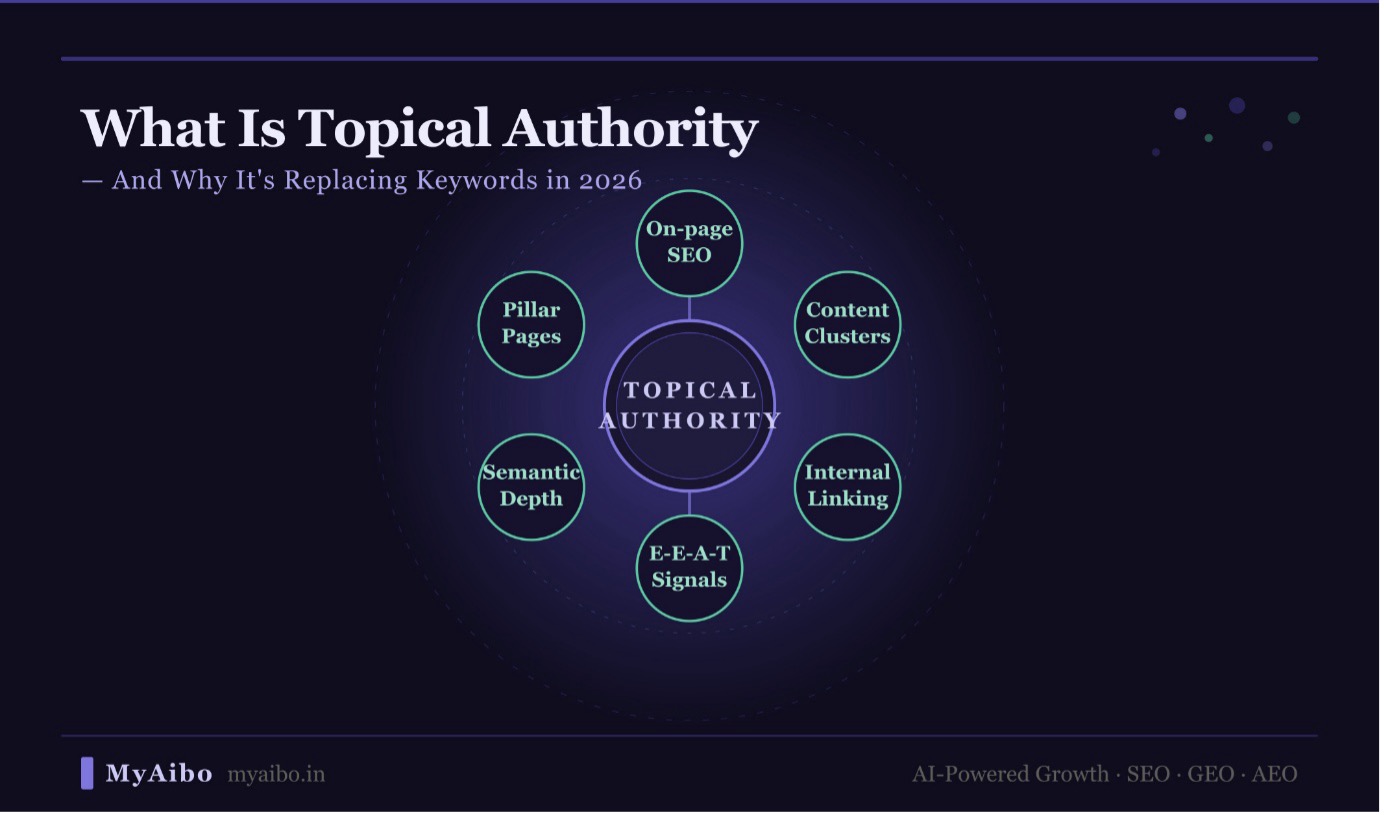
The Pillar Page (Hub): A comprehensive, long-form piece of content that addresses a broad topic at a high level. Think "The Complete Guide to Digital Marketing" or "Everything You Need to Know About E-commerce SEO." This page does not try to rank for every subtopic, rather it provides a birds-eye view and links out to every cluster page beneath it.
Cluster Pages (Spokes): A series of detailed, focused articles that each go deep on one specific subtopic. Each cluster page links back to the pillar page and where relevant, to sibling cluster pages. For the digital marketing pillar, cluster pages might cover: SEO fundamentals, content strategy, email marketing, paid advertising, social media marketing, conversion rate optimisation and so on.
Internal Linking: The connective tissue. Every cluster page must link back to the pillar and the pillar must link out to every cluster page. This creates a coherent web of topical relevance that search engines can crawl and interpret.
This architecture serves a dual purpose. It tells Google that your website has comprehensive coverage of the topic. And it creates a far better user experience because visitors can explore a subject from multiple angles without ever leaving your site.
For a deeper technical walkthrough of how to build and execute this model, Search Engine Journal's guide to topic clusters is one of the most practical resources available.
Why Indian Businesses Are Behind And Why It Matters Right Now
Here is the uncomfortable truth: a significant majority of Indian businesses, from D2C startups in Bengaluru to manufacturing companies in Pune, are still running keyword-first SEO strategies that were outdated years ago. The gap is not small.
Walk through the websites of most Indian SMEs and mid-market companies and you will find the same patterns: thin blog posts written around single keywords, no internal linking architecture, no evidence of a content strategy and pillar pages that are either absent or not functioning as intended.
This is not a criticism; it is actually the market reality. The SEO agency ecosystem in India has been slow to transition from keyword-centric models to topical authority frameworks, partly because topical authority is harder to package into a monthly deliverables report and partly because it requires a longer-term mindset that many clients are reluctant to commit to.
But the window of competitive advantage is open right now. In most Indian niches like the fintech, health and wellness, B2B SaaS, real estate and legal services, the topical authority landscape is remarkably thin. The businesses that start building comprehensive topic cluster architectures today will have a commanding head start within 12 to 18 months.
At MyAibo, this is precisely the gap we work to close. Our AI-powered content systems are designed to identify topical gaps in your niche, build out cluster architectures and create content that signals genuine expertise to search engines and not just keyword stuffing dressed up in modern clothing.
How to Build Topical Authority: A Practical Framework
Step 1: Choose Your Core Topics Strategically
Do not try to build authority on twenty topics simultaneously. Pick two or three core subject areas where your business has genuine expertise and where there is realistic search demand. Depth beats breadth, especially in the early stages.
Step 2: Conduct a Topical Gap Analysis
Map every question, subtopic and search intent within your chosen subject area. Tools like Semrush's Topic Research and Ahrefs' Keywords Explorer are useful here, but the real work is conceptual because it is about understanding your audience's complete knowledge journey from awareness to decision.
Step 3: Build Your Pillar Pages First
Before you write a single cluster article, build the hub. Your pillar page should be comprehensive enough to serve as the definitive overview of the topic, while leaving clear pathways into deeper subtopics. Plan the internal links before you write.
Step 4: Develop Cluster Content Systematically
Write cluster pages in logical groups, not randomly. Cover all the subtopics around one aspect of the pillar before moving to another. Consistency of coverage within sub-themes signals depth to Google more effectively than scattered posts.
Step 5: Link Obsessively and Coherently
Every new piece of content should be integrated into the cluster architecture immediately. Add internal links from existing relevant posts. Update the pillar page. Treat your content library as a living, interconnected knowledge base rather than a blog archive.
Step 6: Measure Topical Authority, Not Just Rankings
Track metrics that reflect genuine authority: organic visibility across your topic cluster (not just one or two flagship keywords), average position for subtopic queries, pages per session from organic visitors and branded search volume growth over time. These signals tell a more complete story.
The Bottom Line
Topical authority is not replacing SEO. It is SEO in 2026. The brands and businesses that understand this shift, who are able to recognise Google as an entity-understanding machine rather than a keyword-matching tool, will compound their organic advantage year after year.
The businesses that keep publishing one-off keyword articles into an unconnected blog will continue to watch their rankings erode as more strategically built competitors pull ahead.
For Indian businesses especially, the opportunity is real and the timing is right. Most competitors are still behind. The question is whether you will be among the first to build something genuinely comprehensive or whether you will still be catching up two years from now.
If you are ready to move from keyword tactics to a topical authority strategy that compounds over time, let's talk at MyAibo.